They all fall into 7 Buckets
We’ve discussed HERE that the purpose of a system is to produce an output. And we talked HERE about documenting the systems that produce those outputs so they are repeatable & scalable. Those outputs are the only reasons to spend money in your company. And they all fall into one of seven buckets.
This is a high level approach that you can use to view the entire organizational structure of your company. Most people use an org chart for this but that’s a very limiting tool. Rather than look at people’s job titles and where they fit in the hierarchy, I’ve found it’s more powerful to use Output Thinking – view the company through the outputs people need to produce. That’s because the outputs, not your people are the building blocks of your company. The simple reason for this is your people will move – good ones will be promoted, some will leave, others will come on board. You don’t want the company to topple like a set of Legos when people move around. You want people to be able to move where they can do the most good for building those blocks.
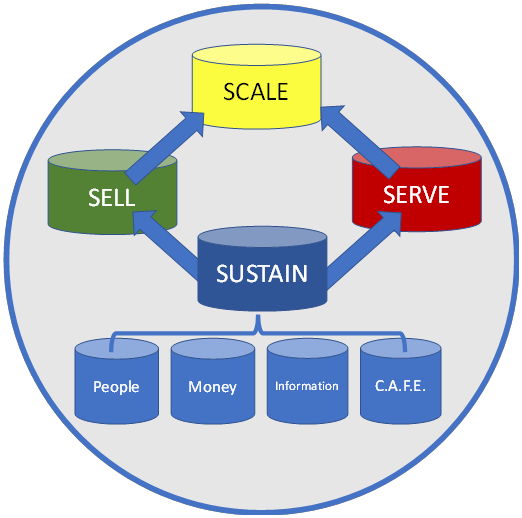
There are certainly differences between companies, but at one level they all need to produce the same outputs. Indeed, as Peter Drucker said, “The purpose of a business is to create a customer”. At that level, every company has the same purpose. That purpose is served by producing outputs and those outputs fall into what I call Seven Buckets. Let’s look at each of them starting in the middle of this image.
The SELL Bucket
A business isn’t a business until you sell something. This bucket contains all the production of leads and closed deals that result from those leads. It also includes the management of sales people, market strategy, and plans. It’s pretty obvious to see which outputs land here.
The single most all-encompassing metric for sales is CAC – Customer Acquisition Cost. This is what it costs to acquire a customer (or in some business models to make a sale). It’s calculated by taking all your marketing & sales costs including people’s time for a 12 month period and divide that number by how many customers you acquired (or sales you made).
The SERVE Bucket
When you sell something you have to provide it to fulfill the sale. I call that serving the customer whether they bought a product or a service or some other form of value. This bucket contains design, production, procurement, assembly, delivery and customer success. If you sell a service, many of those words are different (procurement is really hiring, for example). But the outputs are analogous.
This bucket’s metrics is COGS (the cost of goods sold) and your gross margin. It’s unfortunate that standard financial statements don’t treat the payroll of people who produce what you sell as COGS. I recommend you talk with your financial people to get reports that include those costs there.
The Sustain Bucket
This bucket is really four buckets that exist to sustain the selling and the serving. These are at the bottom of the diagram because they support more selling and serving. They are the back office work that keeps the lights on so to speak. Here are the four:
People – all the outputs of hiring, managing, training, and the like go here. It’s more than typical HR.
Money – bookkeeping, invoicing collections, reporting, and all the financial analysis that you should be getting to help you make better management decisions are in this bucket.
Information – how your people access the data, knowledge, insight and wisdom that they need to do their best fall in here.
C.A.F.E. – This bucket is a list of things you need to pay attention to so they don’t cause problems when ignored for too long. The name stands for Compliance, Administrative support, Facilities & Etcetera.
The Scale Bucket
This bucket is at the top of the picture. It contains all the outputs that help your company grow; things like strategy decisions, plans, goals and KPIs.
Why This is Useful
Every company needs outputs in all the buckets but the amount of those outputs and the robustness of the systems that produce them change as the company scales and matures. Just like every person needs to eat, sleep, play, work, learn etc. But how an infant does it is different from how a teenager does it and different again for an adult. Another example is the difference between a one man band and an orchestra if they were both playing the same tune. The one man band does everything himself – plays all the notes, gets the gigs, repairs the instruments etc. In the orchestra there’s no single musician who plays all the notes in the piece. And there’s a conductor on stage who doesn’t play any of the notes.
What to do First
So … the first thing to do is make sure the buckets are balanced for the stage your company is currently at. By that I mean you don’t want to put effort into selling things you can’t make, or making things you can’t sell. Likewise with the sustaining buckets. Solopreneurs don’t need to spend a lot of effort on these activities, for example. But larger companies may have to spend so much that if affects their cost structure and pricing.
Then and only then should you think about scaling. This means you have to increase the capacity and/or the robustness of the systems that produce the selling and serving outputs your company needs. When you do this, you must keep systems in sync so you don’t get out of balance. Here’s an example told to me by VP of a web development company with about 100 employees. He had been there when the company started and told me they used to be able to create a website for around $5,000. Now, he said, with so many employees they couldn’t touch one for under $20,000. But we agreed that his customer base and offerings had improved as well. Companies that hired them now wanted 24/7 support and security features. Those customers would be scared to death to have a website done by somebody working alone for only $5k. They were able to upgrade their customer base, offerings and pricing as they adapted to a different cost structure.
The Only Reasons to Spend Money
These seven buckets represent the only reasons to spend money, hire people, or to use your time. If it won’t result in more sales, better service to customers, improved support or scaling then you probably should take the money out of the company for something else. One metric for this is ROIC – return on invested capital. Many SMBs grow despite the investments made by retaining earning in their company, not because of them. But that’s a topic for another post.
I’ve been helping company owners balance their outputs and scale their companies for over 25 years. If you’d like to see if I can help you – let me know HERE.