The problem is the exceptions – and that’s the rule!
There are so many benefits to systemizing your company. Without systems, work gets done by people with a lot of knowledge, expertise, and intuition. But that wisdom is locked in their heads. I call it Grandma in the kitchen with no recipe. The food is wonderful, but you can’t scale a restaurant with Grandmas. When you systemize you can push work down to the lowest level. Here’s a great illustration of this that I got from Jon Matzner.
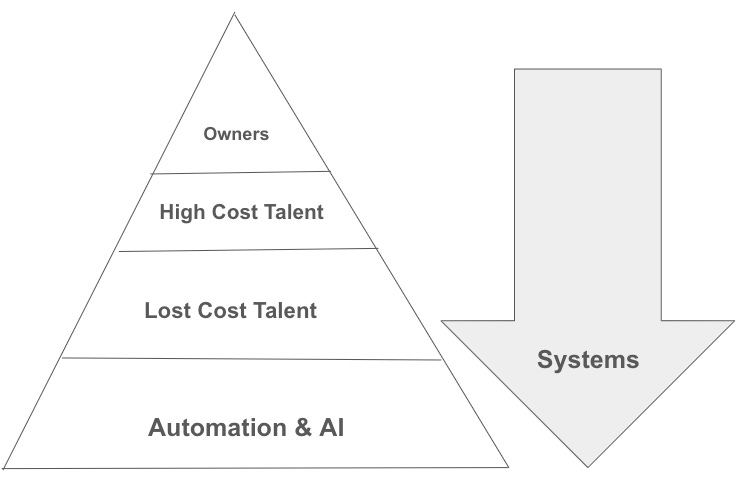
A systemized company means:
People spend more of their time doing work that they are especially qualified to do.
People like their jobs better when they can play at the top of their game.
Work is done at the lowest cost possible.
It because easier to train people and promote them as you identify what they need to learn to move up the pyramid.
Systems Are Simple – Unless Judgement is Needed
As I’ve said before, there are 4 parts to a system.
A trigger that starts the system
An input the system works on
A transformation that changes the input into …
The output which is the reason for the system
If all the judgement happens when designing the system not executing it, then it’s easy to push things down the triangle. The problem comes when judgement is required in the middle somewhere. Here’s an example of a simplified Accounts Payable System.
Trigger – usually a date. We pay invoices on the 15th and 30th of each month.
Input – an approved invoice. (Approving the invoice is a separate system performed ideally by a different person for fraud protection)
Transformation – inputting the details into the accounting systems and clicking SEND
Output – the system sends the money to the vendor.
Simple enough. No judgement required. BUT if there’s a cash crunch you might want to delay some invoices. Which ones and how much you delay requires judgement. Or you might want to pay some invoices sooner than normal to maintain a good relationship with the vendor. The requires judgement as well as an understanding of the cash ramifications.
Those are all exceptions to the normal accounts payable system.
Almost Every System has Exceptions
Exceptions are where judgement is required. This is most of what complicates software. Here’s Steven Sinofsky on why it’s so hard to automate systems using software.
The best diagnosis for exception handling I can think of is to wait on line at the post office. If you’ve ever done that, you know the thought of “doesn’t anyone just want to mail a package” comes to mind. As it turns out the entire flow at the post office (or DMV or tax office) is about exception handling. No amount of software is going to get you out of there because it is piecing together a bunch of inputs and outputs that are outside the bounds of a system.
The ability to automate hinges not just on the ability to know the steps to take for predefined inputs, and not even the steps to take if some inputs are erroneous or incomplete, but what to do if you can’t even specify the inputs.
(Sinofsky was a high-ranking executive at Microsoft during the formative years of Windows. You can read his whole post here. )
Software is the lowest level in the triangle above. And software has no judgement. It may someday when AI is more robust. But till then, it’s common to thing the solution is people – Grandmas with lots of experience. But nobody can have enough experience to handle every exception. And sometimes people are more prone to errors than a computer.
What’s the Solution?
As you document and/or design your systems, start to look for the exceptions and where judgement comes into play. Then consider how to deal with those situations Here are some suggestions.
1. Break the system into subsystems so that judgement is made first and then the rest can be passed down the triangle. For example, with accounts payable, once an invoice has been approved, someone can decide which invoices get paid when. The outputs of those decisions can then be the inputs to a more routine payment system.
2. Describe what an exception looks like so it can be kicked out of the normal system and sent to someone else who can deal with it properly while the rest of the inputs are handled in a normal way.
3. Group the exceptions into categories. Then triage. Often what looks like an overwhelming number of individual cases turns out to be multiple instances of a limited number. This is very common with emails and customer service issues. It’s very tempting to think “We can’t promote Marcia because nobody could handle the complaints as well as she does.” But when you look deeper you find that the majority of the complaints fall into one of 6 different types. Someone can be trained to label each complaint with what type it is. That’s what I mean by triage. Ones that don’t fit neatly into one of those 6 types can be sent to Marcia, but the others can be handled by people who can be trained on each type.
The Result?
When your systems are well designed, and exceptions taken into account, you’ll get a lot farther pushing things down the triangle for more profit, better outcomes and everyone playing at the top of their game.
Want More?
If this was useful I can help you systemize your company in the following ways.
1-1 Coaching – I only work with a few clients at a time but anyone can sign up for a free session. Building systems is something I can help with.
My book Output Thinking