Separate Before You Delegate
I’d be fine earning half as much money if I could get my time back.
That’s a common theme I hear from business owners. And the solution is NOT time management.

Ahmed was thinking about this a few weeks before his third child was due. In fact we had to delay working together because the baby came a few days late. With the kids outnumbering the adults in his house, he was ready to make some serious changes.
He’d been in business 20 years and had opened up several locations of his math tutoring school. He had a team of well-trained instructors though he still did some teaching himself. His office staff was mostly remote so he didn’t need the expense of an office – he worked out of his home.
There were two problems he wanted to solve when we first started working together and a third that came up early in our sessions. They all had similar solutions.
He was spending too much time in the car. This was time that wasn’t productive and it kept him away from his family.
He spent too much time on email. This was productive but felt overwhelming and kept him from the more important things he wanted to do.
He had a vision for how the company could grow and he was frustrated trying to bring it to pass.
The company was doing well in his immediate tri-state area. In the past he’d tried to open in a few other states but they failed spectacularly because he couldn’t keep things going that far away from his home base.
At one point he told me he’d be happy making half the money if he could get his time back.
The company was working – maybe not as well as he’d liked but there was nothing that was about to blow up. This is the ideal time to systemize a company. You can do it when a quick turnaround is needed but you have more flexibility when things are working.
The reason Ahmed was feeling overwhelmed is he was thinking about WHAT he had to do not WHY it needed to be done – a common situation if you’re not schooled in systems thinking. Here’s what I mean.
Remember when we discussed the 4 parts of a system? I covered that here.
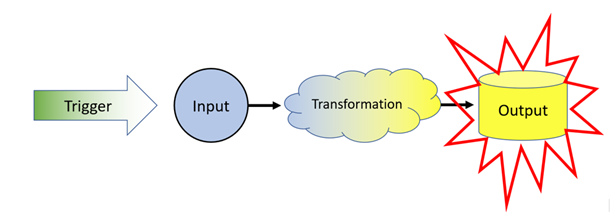
The output is the reason why you do something, the transformation is the work you do. Email was Ahmed’s #2 problem but since it’s the easiest to explain we’ll start there. Reading and answering email is the work, the transformation step. It takes input (an email) and transforms it into an output (usually a response, a meeting request, or an action item). There are different categories of outputs required from different emails and this made Ahmed feel like he didn’t have anyone he could hand off this work to. This is why it’s important to separate before you delegate.
So the first thing he agreed to do was keep a log of the different types of emails he was dealing with. There may be hundreds of emails but they usually fall into less than a half dozen types. Using those types, we can triage the emails by urgency and importance. Here are some of the outputs that are typical for a service business.
A sales inquiry. These need to be broken down further by the type of customer or sale.
A customer problem. These also fall into a finite number of problems, each with a clear way to solve them.
An inquiry from staff. These could be a scheduling request, to an idea for a better way to do something, a request for supplies, or something else.
Miscellaneous. These are things that are unrelated to each other, but rare.
Looked at like this, the solution was simple. Not easy, but simple. By separating the work from the outputs, we can organize the outputs into relevant systems. Then, since the company is working we know those systems are functioning – they are producing the proper outputs. So from there we do the following.
List the systems that are needed. Those four outputs will likely become less than a dozen different systems. (I’ll write soon about the number of systems your company needs. There are patterns that apply to every business.)
Document the 4 parts of each system. Documenting each has the following benefits:
Documenting the trigger will determine if it needs to be handled right away or can be batched or scheduled later. This requires a triage system.
Documenting the input will make sure the work isn’t started till it can be finished.
Documenting the transformation step allows you to training others to do the work properly.
Documenting the output means you can now track the work and monitor performance.
Assign each one to the right person. Then use the documentation to make sure they’re trained.
If you look at the list of Ahmed’s problems, you’ll see that email is #2. Here’s why I think the solutions to all three problems are similar. They all follow the same process that goes like this: SEPARATE then DOCUMENT then DELEGATE then MANAGE.
Problem #1 – Driving too Much
The problem that was causing him the most pain was driving. The solution here is similar.
List the outputs of each of his trips. In other words, know why he was doing it.
For each different reason, document the best way to provide this output.
In this case some of the trips could be replaced by video call, others could be batched together to eliminate needless trips. This means improving the system, not just delegating it to someone to do it the way it’s being done now.
Assign those outputs to the best person – and be sure they are trained.
Monitor the outputs and make adjustments as needed.
Problem #3 – Implementing his Vision
The reason his expansion plans failed in the past is that he tried to implement them the way he’s build the company for 20 years: using the brute force of his expertise and experience. It’s like the grandmother who makes really good food but doesn’t follow a recipe. It’s obviously not going to scale. But there’s also the overwhelm factor. Grandma can only make so many different dishes at once. She may have the soup on the stove, the main course in the oven and the desert on the counter. Whenever there’s a break in one she jumps to the other to give it a stir or add a little salt. She can’t handle any more.
But a restaurant differs from grandma’s kitchen in two ways. One is there’s a recipe. That’s the documentation I’ve been mentioning. But the other difference is separation of duties. There are sous chefs and line cooks and prep cooks each with different responsibilities. The outputs they produce come together on a plate that goes out to the customer. But because the duties are separate, they can each be worked in a focused, efficient way.
By dealing with the problems of driving and email, Ahmed will free up his time to focus on expansion. But that won’t be enough. He’ll need to separate the expansion project into different systems or sub-projects. Each will have a different type of output. Then he’ll document, delegate and manage them one by one. He won’t be successful if he tries to just delegate the whole thing. But because systems are repeatable, he’ll be able to scale more than once.
This is very different from the way Ahmed has been working: responding to whatever situation arose. Because he’s good he’s been able to do that for 20 years. But he’s reached his limit. At least with the business. I don’t know if he’s reached his limit with kids. But I know as he implements the systems in his company, he’ll have more time to spend with all his kids.
Is this working for Ahmed?
It’s too soon to tell – we’ve only had 3 coaching sessions. But I’ve seen this process work with my own companies and with many other clients. So I know the process works. The variable is Ahmed. Will he follow through? Here’s why I have confidence he will.
He told me the following that indicates a change in his approach:
I’m thrilled with this high level approach to running my company. I’m looking at the business differently. I feel like I’m thinking in different ways.
But it’s not just words. He’s also made the following changes that indicate he’s willing to hand off systems to others:
He gave his office manager a project to look for software to improve their scheduling system.
He connected with a local company so he can outsource some of his fulfillment.
He hired a contractor to do some work for him. Something the old Ahmed would have done himself (if he’d had time).
He found that much of the driving he was doing didn’t require his personal presence. So he promoted one of his employees to be a manager at the location he was driving to most often.
All this in just three sessions! When he told me he’d be OK with half the money, I reminded him that his kids are young. They get a lot more expensive as they get older and he might not be as happy as he thinks with half the money 😁. I also told him I thought he could have both more time and more money and that it would happen sooner than he thought.
I don’t usually write about my clients so specifically (and I’ve changed some details here to shield his identity). I’m tremendously grateful to the clients I’ve worked with for 25 years who have shown me that the concepts I’ve implemented in my own companies are not just a fluke of my particular ability; but they have a more universal application.
In the next month or so I’ll have time to work with a couple more clients like Ahmed before I do a waitlist. Book a time with me HERE if you want to talk about it.