How to get away from the day to day routine
OK so you’ve been reading my posts (that’s about half of you) and applying this stuff (that’s probably half again). What’s happened?
You’ve developed systems.
You’ve documented them – all four parts.
They’re mature systems.
But it still feels like you can’t get away for more than 2 days without everything going cattywampus. (Isn’t that a great word? But I digress). Here’s how to grab your time back.

What’s missing?
What’s usually missing is the idea of frequency. That means how often a system needs to be run. And it’s not a function of the system itself. Why? Remember the reason we run systems is to produce outputs. Outputs are the ends; systems are the means. And it’s the output that needs to be produced at a certain frequency. If your name is attached to that output, you’re tied to its frequency. (This is what’s usually the problem, for most people. If you want, schedule a free coaching call and we can talk about the details in your situation).
How Often?
Some outputs are needed hourly. Some daily. Some weekly, monthly, quarterly etc. You can put them on a calendar. Payroll is run every other Tuesday till the end of time. But some outputs are triggered by an event, not a time or date. You can’t put them on the calendar but you can look at the history and get an idea of how often it’s likely to occur. Then you can make a chart like the one below. (You can start with just the parts of the chart with your name in that last column if you like.)
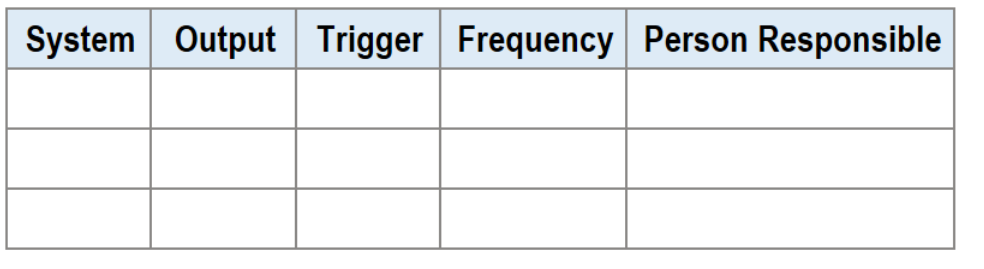
Remember to account for seasonality. Certain event triggers are more likely to occur at certain times of the year.
The Answer You’ve Been Looking For
Look at the rows with your name in that last column. The data in the “frequency” is what keeps you from getting away. So there are two things to work on.
#1 Delegate
Offload (aka delegate) the work in the most frequent rows. Here’s how.
Train someone. Make sure they can do it to your standards (maybe not as good as you, but good enough).
Ask them to do it a few times as a trial run. This is how you delegate without abdicating as the saying goes. Put their name in that row instead of yours.
You can make them responsible for the task without giving them a promotion. Consider it a temporary assignment till you’re confident in their ability to handle any unexpected situations.
The Training Grid might help. Here’s a short video about it.

#2 If you Can’t Delegate, Subdivide
What does that mean? Sometimes a system that produces an output can be broken out into several subsystems each one producing and output that’s the input to the next. A prime example of this is interviewing a new hire. Perhaps you feel that no one else can make the final decision about who to make an offer to and delegation isn’t appropriate. But maybe rather than interviewing every candidate, you can subdivide the interview system and someone else can do the interviews that filter for technical competence and you can do the final interview for cultural fit. Or vice versa. That way some number of candidates are eliminated early and you don’t have to spend as much time on interviews – and being shorter they can be scheduled in a batch. This frees up your time.
That’s just one example. But whenever you sense that you can’t delegate an entire system or train others to produce the entire output, look to see if it can be subdivided and parts of it handed off to others.
What does Get Away Mean to You?
Once others are doing what they can do, you’ll be spending time only on things that require your expertise. That gives you more time for other things. What are those other things? It depends. Getting away can mean different things. For some it’s a month-long vacation once a year. For some it’s freedom to work on more strategic activities in your company (those usually have a slower frequency.) This means they’re less urgent but could be more important. For others it means looking to acquire or start other companies. That’s what I did. When my video business was running without frequent demands on my time, I started coaching and eventually helped start the International Coach Federation. I’m no longer involved in ICF, but I continue to coach.
If you found this useful, here’s where you can find more like this.
My book Output Thinking where I talk about how thinking in outputs makes you a better manager.
1-1 Coaching – I only work with a few clients at a time but anyone can sign up for a free session. A coach can help you develop and apply your abilities as a manager and/or a leader.
I tweet a lot @BetterCEO
This free newsletter. If someone forwarded this to you, Subscribe here.