There’s a huge difference between 98% and 100%
The first 90% of the job takes 90% of the time. The last 10% takes the other 90% of the time.
But it’s worse than a time suck. Here’s why. The typical CEO I work with runs a company of $1M – 20M in revenue, 15-200 employees. Some more, some less. What they all have in common are these two competing demands on their time.
There’s Tension Between Those Two Things

They have a handful of projects they’re working on to move the company forward. These might be things like opening up new markets, developing new offerings: projects that increase the top line. Or designing better workflows, empowering employees, improving systems: projects that improve efficiency and increase the bottom line.
They are also responsible for some outputs that happen monthly, weekly or (GASP!) even daily to keep the company moving. There might be certain deals they close, orders they fulfill, work done for key customers that they personally oversee or any number of activities that must happen just to keep the company chugging along in the present.
This is the difference between working ON your business and working IN it.
The tension is about urgency. Work that keeps the company afloat is more urgent than that which builds for the future. But often the other is more important. What I’ve seen so often is the urgent work gets completely done but the important work gets mostly done:
Workflows are almost redesigned
Things are almost handed off
Groundwork for new markets in begun but never finished enough to fully commit.
Mostly done is not done.
For the non-urgent projects, they are done when you don’t have to revisit them again. Sure, there’s routine maintenance that needs to be repeated and if circumstances change then you may have to go back to the drawing board. But a pattern I’ve seen with many SMB owners is they move on (or get called away) before these projects are fully finished. Often it’s the urgent work that they’re still responsible for that calls them away.
Here’s a tip. List all the projects you’re working on in a chart like this one. NOTE: the second column is the most important. Success (aka the end state or the output) must be defined in an objective, visible way. If your definition of success is squishy do not go forward until you can express it clearly.
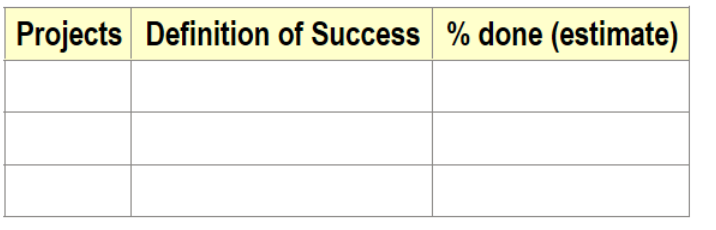
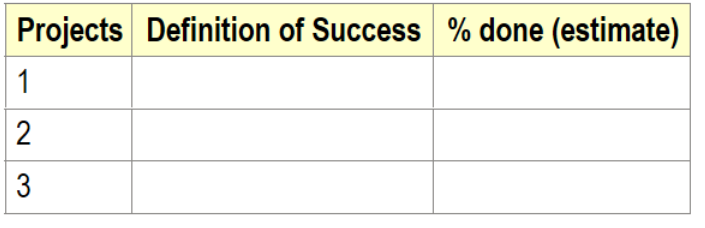
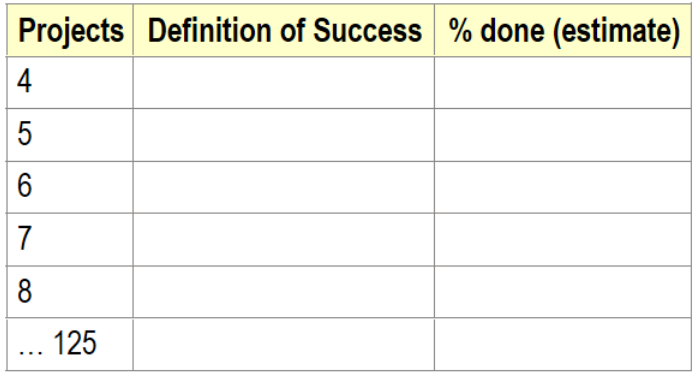
If there are more than 3 projects in your list, you need two charts. A chart of active projects (limited to 3) and a chart of someday projects where you keep all the others. You can’t work on a someday project until it’s active, and you can’t move a project from someday to active unless you finish (or kill) one of the active projects. Although you can put it on hold if you’re waiting for input from someone else.
ACTIVE PROJECTS
SOMEDAY PROJECTS
Here’s Why This Works
You’ll be more effective finishing a few projects before you work on many. You don’t reap the benefits of a project till it’s done. If you work on many, a year from now, you’ll have made a little progress on most of them, but if none are done, you’ll get no benefits at all.
What are your top 3 projects?
Post them in the comments and let me know.
If you found this useful, here’s where you can find more like this.
1-1 Coaching – I only work with a few clients at a time but anyone can sign up for a free session. Building systems is something I can help with.
My book Output Thinking
Follow me on Twitter @BetterCEO
This free newsletter. If someone forwarded this to you, Subscribe HERE