Does that sound contradictory? Read on
A business owner writes “I would like to eliminate all job duties from my plate and have the business run itself.” Many of us want that too. And often learning about systemization and Output Thinking seems like the way to do it. I don’t disagree. But doing it in practice is harder than it seems. Here’s how to get started.

Let’s go Back to Basics
Why is your company allowed to exist? I don’t mean by the government; I mean by the market. Your company exists because it produces something people want to pay for, and it finds those people. Then it builds an organization to repeatedly find those people and make what they want to buy. And it does all this for less money than customers are willing to pay. There are lots of moving parts in accomplishing that. The specifics depend on what you produce, how you sell it and other factors. But all those moving parts produce what I call outputs. Many of those outputs are inputs to other systems internal to your company, while some of the outputs are delivered externally to customers, vendors, employees and the like. It’s the ultimate delivery of external outputs that allows your company to exist.
As a primer, here are some things that I consider outputs that you may not think of in that way. But I do because they are a result of work and important to your company’s existence. (This is an incomplete list.)
A thing – make a hamburger, a widget, a sale
A change in status – make a room clean, inspect a part & make it accepted or rejected
A behavior – an action visible by others
A decision – eg giving credit, hiring, prioritizing
Solving Problems – at the right level in your company
Relationships – common outputs for Biz Dev people and business owners
Each output has certain properties or qualities that make it useful. (This is another incomplete list – and not each of these applies to every output).
Quantity – how many or what size it needs to be
Quality – how good it is and how “good” is defined
Capacity – how many can be produced in a period of time or by a person or team
Training / Certification – what’s required to be able to produce the output
Cost – what it costs to produce
Frequency – how often it must be done THIS ONE IS OUR FOCUS TODAY.
Who Should Produce Which Outputs?
Notice that none of the properties includes the job title, role, or person who must produce the outputs. That is arbitrary. And it changes as your company grows. In fact, there are companies (some rather large) which don’t have any job titles or roles at all. But they are certainly producing outputs.
In an ideal company structure, people produce the outputs that they are especially qualified to produce. They are able to use their “superpower.” or as I’ve said, Everyone Plays at the Top of Their Game. A company structure that supports this does not happen organically. It must be designed.
Why You Feel Overwhelmed
Unfortunately many business owners grow their organizations without applying the concept of designing the structure around who should produce each output. And when they can’t find the right person to produce one or more of the outputs that the market requires for company survival, they do it themselves. After all, if it doesn’t get done, the company might not survive. But that often means they aren’t playing at the top of their game. And they feel overwhelmed. They don’t have time to do the strategic, important work they’d like to – or even read a book in a hammock like Santa does most of the year.
What to do Now
Start by listing all the outputs you produce. The first time people do this they often list the work they do. They use verbs not nouns. But take it one level deeper and list the output (the result, or deliverable) of that work.
In the column next to each output, list just one property of that output: the frequency with which it must be produced.
Some frequencies are calendar based. (You produce payroll checks every other Thursday)
Other are triggered by an event. (You reorder supplies whenever the inventory reaches a certain level). Guestimate how often this happens and put that down.
Now pick a single output you want to get off your plate and train someone else to produce it. When they are good enough, hold them accountable to produce it on that frequency.
Now add a new output to your list – following up to make sure the other person is doing it appropriately. (Follow up is an output.)
Repeat steps 3 and 4.
Point #4 is Important
People often don’t take the time to follow up. But you must. Otherwise you’re abdicating, not delegating. (Hat tip to Patty DeDominic for this idea.) The good news is that follow up is less frequent and less time consuming than producing the output was and it can be temporary. For an output that needs to be produced daily, you might start by checking two or three times a week. Then scale it back to two or three times a month, then hand the follow up off to someone else.
It’s simple, but not easy. If it were easy, even a caveman could do it. But this is the hard work of being a CEO.
If You’d Like Some Help
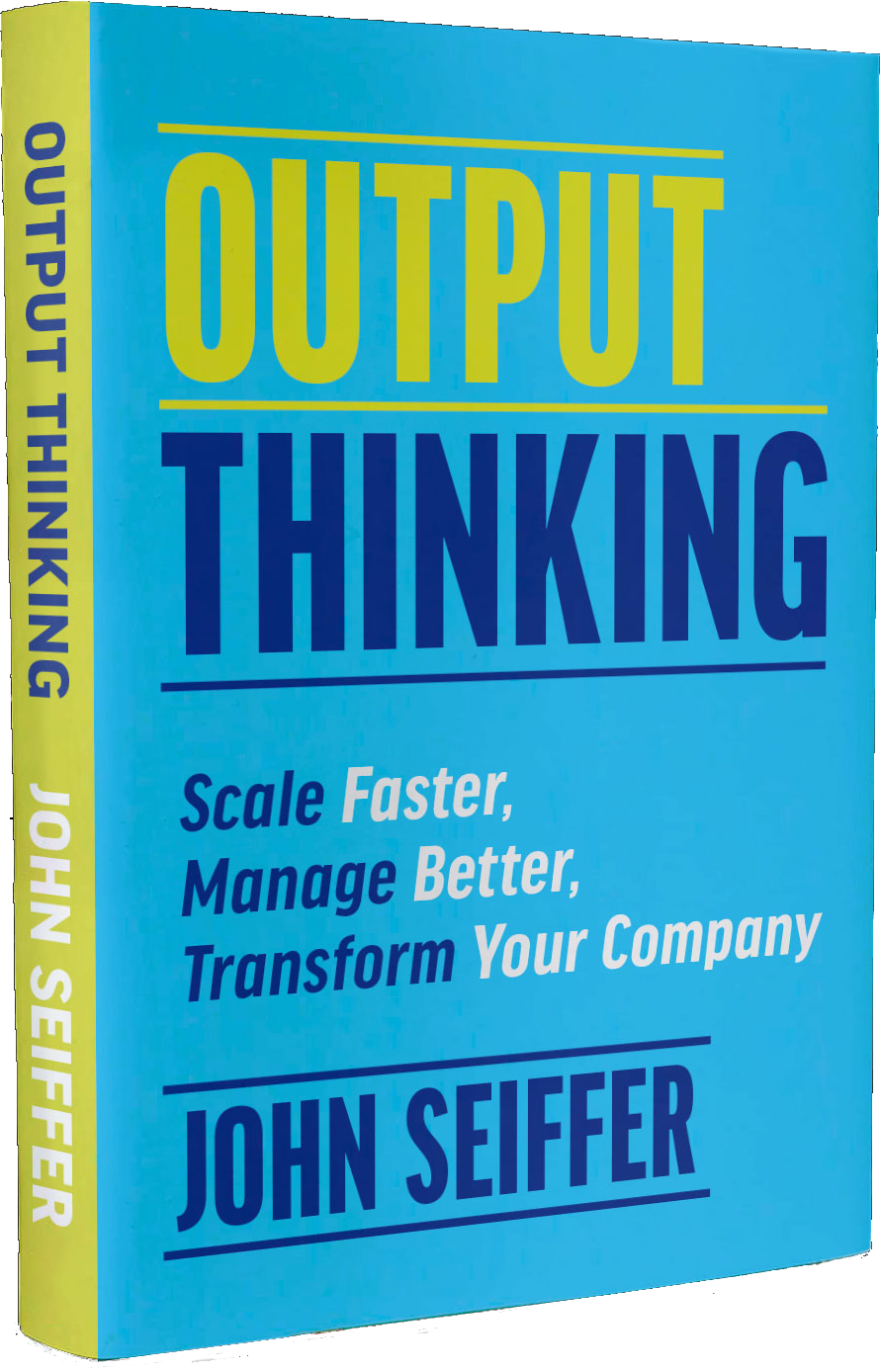
Start with my book – Output Thinking (and after you buy it, please leave an honest review – it kicks the algorithm into gear).

Sign up for a free coaching session. I promise it’s a real coaching session, not a sales pitch.