Yes. Sort of. But that’s where the money is.
This post is a long answer to a question raised by Tim Ludwig – @tsludwig on Twitter (now X). Tim asked:
If you were developing a scorecard or checklist to assess a company’s organizational health, what would you include?
I’m thinking mostly top-level things that are generalized items that cross over business types, industries, etc. Examples – in an idealized, healthy org – might include:
Well-documented processes
No single points of failure (staff, systems, etc)
Deep and tenured senior management team
Strong balance sheet
What else?
Thanks Tim
First let’s define a fractal.
A fractal is a structure where each part exhibits the same characteristics or “shape” as the whole. The Sierpinski triangle shown below is an example.

A tree is also an example of a fractal. It has a central structure (a trunk) with different limbs fanning out from it. Each limb also has a central structure with branches fanning out from it. And a leaf also has the same basic shape. But at the lowest level, this structure breaks down. The cells of a leaf are different from that of a tree trunk because they have specific roles to perform.
We see a similar pattern in businesses. At the highest level they all look similar across business types and industries. And as you get deeper into the organization they look similar as well. But at the lowest level they need to be specific to their situation. Example: all companies need to bill customers and collect money. But the details of how that’s done are different in a mom and pop retailer than they are in an aircraft manufacturer.
Let’s see how that analogy helps us understand a company.
Let’s look at what a company has to do
Companies must produce outputs (results) in seven categories – I call them buckets. They must:
1. Serve customers by making something they want to pay for
2. Sell by finding those customers and closing deals
Then to support the serving and the selling they must:
3. Hire and manage people and provide them with support to do their best work
4. Track the money and learn what insights the financials contain
5. Make sure information is available to everyone who needs it so decisions can be made wisely
6. C.A.F.E – this is a process to make sure the company is not at risk of disasters that I won’t go into here.
Finally to grow, the company must:
7. Scale – develop the strategy, goals and plans that keep it adapting and expanding.
That’s the highest level, where all companies look similar.
Now let’s look at how those outputs are produced
There are two ways: either by individuals with experience and intuition, or by individual operating systems.
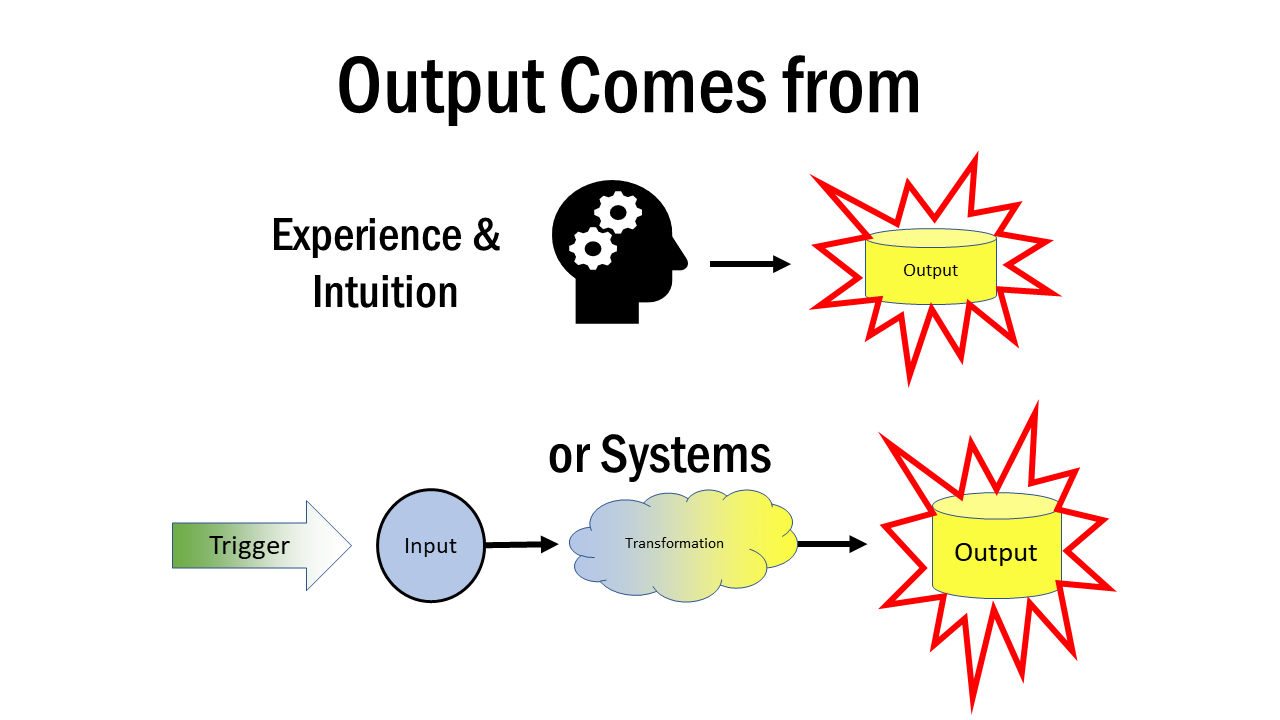
Companies that rely on intuitive, experienced individuals without providing a system within which they can be their best are limited in their ability to grow. This is the scenario of a grandmother in the kitchen who doesn’t use a recipe. Holiday meals (the outputs) are great. But you can’t build a restaurant that way. Grandmothers are too expensive. This is summed up in a quote by Daniel Jones, Chairman of the Lean Enterprise Academy
Brilliant process management is our strategy. We get brilliant results from average people managing brilliant processes. We observe that our competitors often get average (or worse) results from brilliant people managing broken processes.
Finally, let’s look at what makes a system robust
Great systems in a company are robust. I consider a system robust if it has the following characteristics (which I call DAMS).
D – Documentation: written and/or video files that show people how to produce the outputs.
A – Accountability: a person responsible for producing the output.
M – Metrics: measurements to track quantity, quality, costs, and other ways to evaluate the output.
S – Subdivided: subsystems to produce the output most effectively and efficiently.
The S is especially pertinent to the fractal analogy. As systems subdivide, they follow similar patterns in all companies, until they don’t. It’s where the fractal analogy comes from but also where breaks down. I think of it as the science as well as the art of building and running a company.
Let’s take an example of sales. In a small company one person may find the prospects, reach out to them, write proposals, close the deals. That’s a system. The output of that system is paying customers. But as the company grows, it makes sense to subdivide the system. Marketing does the first part of that process and outputs qualified leads which are the input to the second part which produces deals. In even larger companies these may subdivide further, with separate marketing subsystems for social media and advertising and trade shows and separate sales systems for initial demos, detailed proposals etc.
So it’s useful to understand typical subdivisions. And it’s useful to understand you can’t just cut and paste a generic checklist into your company. You have to understand the context in which your company exists and how the size and complexity of your organization determine the optimal level of subdividing your systems.
The Transition from Experience to Systems is Hard
What I’ve found is that intuitive entrepreneurs do well until they stall. At some point they either can’t find enough qualified people or they can’t find enough hours in the day to produce all the outputs they’re responsible for. Some react to that by scaling back. Others burn out or sell the company. (By the way, these make great acquisitions for people who are good at systemization.) And some entrepreneurs learn to systemize. That’s what Melissa Withers calls moving your company from people to process. Often as they systemize, they run into the 90-10 rule.
The joke is that the first 90% of a project takes 90% of the time and the last 10% takes the other 90% of the time. But in reality what happens is you can put in 90% of the effort and not see any benefit at all. It’s only when you put in that last 10% that suddenly all of the benefit shows up. And it’s often that last 10% that’s the art which is specific to your company.
Yes, a healthy company benefits from a strong management team, a strong balance sheet and many other things that Tim mentioned. But a set of DAMS systems is how it gets those things.
So to answer Tim’s question, is there a score card. I call it the Systems Inventory. It’s a process of evaluating all the systems in a company and determining how robust they are. It’s important to remember that the subsystems evolve as a company grows – not just in revenue but in complexity of the organizational structure. So the systems inventory must be revisited periodically.
If you found this useful, here’s where you can find more like this.
My book Output Thinking
1-1 Coaching – I only work with a few clients at a time but anyone can sign up for a free session.
I tweet a lot @BetterCEO
This free newsletter. If someone forwarded this to you, Subscribe HERE