Subsystems are the Key
Imagine you want to delegate dinner. You have someone with all the skills needed. What do you tell them to do? You could say any of these things:
Make me something delicious and have it ready when I’m hungry.
I’d like to eat a large meal at 6:30 just make it vegetarian
I’d like dinner at 6:30 with the mushroom risotto from Julia Child’s recipe and whatever sides go with that based on what we have in the fridge.
I’d like dinner at 6:30 here’s the entire menu I’d like you to prepare
There are times when each of those requests would be appropriate and times when each would be a disaster.

Granularity
The reason most people aren’t good at delegating is they don’t break down the outputs into the proper subsystems. When someone is good at what they do they’re often so intuitive, they only see the ultimate output, not the individual steps it takes to get there. Like a grandmother in a kitchen who makes great food without a recipe.
That’s fine for a holiday meal but if you want to run a restaurant at any scale you need to break down the overall output you want into subsystems. That way the people who do the prep can do it before the rush, and those that do the cooking can do it at just the right time, and the executive chef can develop the recipes. You’ll notice that not only does this make it possible to scale, but it lowers the labor cost because some of these processes can be done by less skilled (and lower paid) employees.
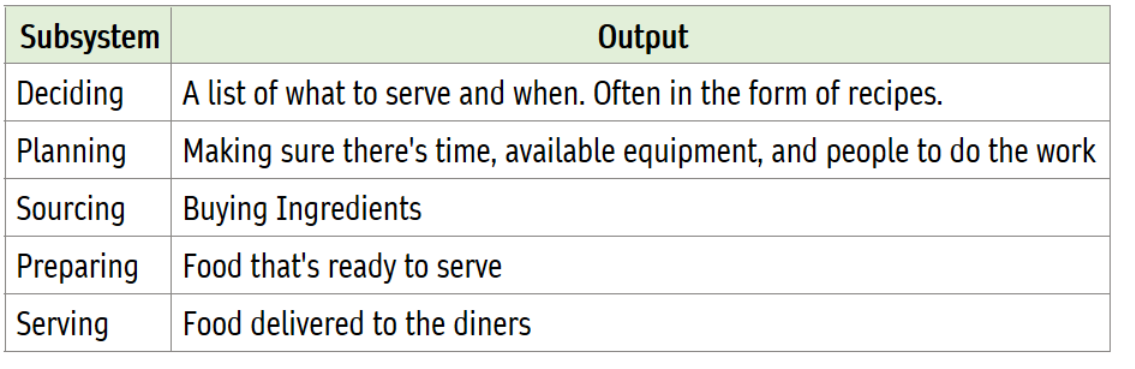
You see, “make dinner” is not one system but several subsystems (at least at scale). Deciding, Planning, Sourcing, Preparing, and Serving are all subsystems of “make dinner.” And each one feeds into the next. That’s what I mean by granularity.
To delegate properly follow these steps.
Break the task into subsystems where each one produces a specific and measurable output.
Understand the inputs of each subsystem (many inputs are the outputs of a previous system).
Assign each subsystem to the person with the right skills, tools and training.
To continue the dinner example:
What about Judgement?
This is not as clean and simple in practice as it is in theory, especially with tasks that require judgement. But if you break down the subsystems to the right granularity, you can assign just the work that requires experience or judgement to someone with the level of skill required, and the rest can be done by others.
Granularity is the job of Management
Rather than call this delegation, you could call this workflow design or even job descriptions. Whatever you call it just know that it’s the job of management, not the employees, to figure this out. You may have an employee or two who can figure it out all by themselves, but like grandma that’s not usually scalable. Perhaps their ability to break down work into subsystems could be put to use in many places in your organization, if that’s their special skill.
“Brilliant process management is our strategy. We get brilliant results from average people managing brilliant processes. We observe that our competitors often get average (or worse) results from brilliant people managing broken processes.”
~Daniel T. Jones Chairman Lean Enterprise Academy
It’s management’s job to design the processes and split them into subsystems at the appropriate level of granularity.
Follow up
There’s one more thing besides subsystems that’s required for good delegation, and that is follow up. Without proper follow up, you’re abdicating not delegating. Proper follow up is not done haphazardly. It’s planned. Schedule it and announce it at the same time you assign the job. Rarely is it a good idea for someone to be surprised by you following up. The more confidence you have in someone’s ability to produce the right output, the less frequently you need to follow up.
The 10-50-90 rule
If someone is new to the job, or you aren’t confident in their ability, use the 10-50-90 follow up. That means schedule the first follow up when you expect 10% of the job to be finished. For a task you expect to be finished in a day, the first follow-up would be in an hour. If the task is expected to take a week, follow up in half a day. The purpose of this first follow-up is to see if the person understood the assignment and if you communicated it clearly. If 10% of the job is not done by then, you’ve caught the trouble in plenty of time.
Schedule the 2nd follow-up when you expect 50% of the job to be done. The purpose of this is to see if the pace of the job is appropriate. Sometimes people take too long because they are working at too deep a level of detail, or perhaps they didn’t give it a high enough priority. A check at this point will alert you to any problems of speed.
The third follow up – at 90% completion is to catch any last minute snafus while there is still a bit of time left to fix them.
Tell Them When to Ask For Help
Often people don’t want to ask for help thinking they’ll seem incompetent when in fact, you’d rather they ask early rather than too late. Be sure to communicate what they should do when they hit a snag. Should they figure it out? Ask you? Ask someone else?
This sounds like a lot of work!
Management is work. But if you do it right, it’s less work and more productive than delegating poorly.
If you’d like to improve your delegation skills, sign up for a free, 45-minute coaching session HERE.