It’s a part of systemizing your company
What is C.A.F.E?
In a previous post the picture has a bucket called C.A.F.E. and I’ve been asked to explain what it is. Someone even asked if it’s clickbait. I didn’t mean it that way.

C.A.F.E is one of the support buckets you need to keep serving customers and selling to them as effectively as possible. But it’s different from all the other buckets. The others are filled by people operating systems or performing tasks which produce outputs. C.A.F.E. is really a list of things that are easily ignored but can cause problems if they are ignored for too long.
My suggestion is to review each of these at least once a year.
The term C.A.F.E. comes from Compliance, Administration, Facilities & Etcetera. Here’s the list that I’ve compiled, but feel free to add your own.
Compliance
When companies start out, they often think it’s necessary to cut some corners in this area. As they get bigger this can become a habit that can bite you hard. A word that goes along with “compliance” is the word regulation. Everybody hates regulations – since we were two years old we hated being told what to do. But think of regulations as a coin with two sides. The other side is protection. Like the regulation to have elevators maintained and inspected protects occupants from accidents and building owners from law suits.
There are many things you have to comply with to be in business and they vary depending on the business you’re in and your location. Here’s a list of some.
OSHA and worker safety
Food safety
Hazardous material handling
Pollution Control
Licensing
Continuing Education
Certification exams
Administrative Support
The first employee I recommend hiring is someone who can provide administrative support. Why? As entrepreneurs, we tend to be big picture folks. But we need someone who can pick up the pieces when we aren’t interested in the details and keep things moving along.
Administrative support can be very specific: like someone who arranges travel, or a person who puts together PowerPoint slides. Or it can be more general. General support goes by many names: Office Manager, Executive Assistant, Personal Assistant. (Virtual Assistant is a title that just indicates the person is not in your office – their location is not all that important.) These assistants used to be called secretaries. But that was back when business executives wouldn’t type. It took days to get a letter out the door. But there was an upside to this kind of support. Secretaries knew what they were doing.
Here’s a definition of an executive assistant from Justin Roff Marsh
Unlike a typical assistant, an executive assistant assumes overall responsibility for the initiatives in which the executive is involved—and also assumes responsibility for the executive’s calendar. The executive assistant maintains an awareness of all the initiatives on which the executive is working (and their relative importance) and plans the executive’s time so as to maximize the yield on their limited capacity.
Good administrative support keeps everyone playing at the top of their game.
Facilities
This basically means people have the physical space to do good work. I include tools and equipment here as well. If you’re a consultant running your business out of a spare bedroom “Facilities Management” means you keep the internet running and empty the trash once in a while. If you run a fab plant making computer chips your facilities management is a little more involved. You’ve probably got PhDs in clean suits working around the clock to maintain the facility.
Many knowledge workers are remote and this often means they provide their own space. But you should consider providing technology so everyone has up to date equipment. And in some cases you might want to provide membership in a co-working space so they don’t have to work from home.
When space is cramped or people don’t have enough good tools their ability to produce the outputs you hired them for will suffer.
Legal
The right legal support can keep you out of trouble and in some cases even add value. It helps to have relationships with relevant attorneys before you need them. Here are some attorney relationships you should consider.
Someone to review your contracts.
Someone to review your HR policies and head off any lawsuits.
Employment agreements will make sure the company owns any intellectual property made by employees while they’re working for you and to make sure if they leave they can’t take customers and/or other employees with them.
Intellectual Property – trademarks and patents and such can add value to a firm and also make sure you aren’t inadvertently infringing on anyone else’s property.
IT Support
You need someone to keep the computers, network, phones, email etc. running and secure; as well as to get new employees set up with the latest technology. As your company grows you’ll probably need a company rather than an individual to do this. A company usually has better response time and expertise in more areas than an individual.
Insurance & Disaster Protection
This is often called “continuity” because it allows your company to continue if there’s a problem. Insurance provides money to recover from a disaster. And some insurance people will help you implement ways to prevent problems. A good insurance broker will sell you the right policies. A great one will tell you which ones you don’t need. Consider policies that replace lost revenue when your company is recovering from an incident.
But there’s more to continuity than insurance. You need to make sure there’s a way for people to be safe, for critical equipment to be quickly repaired or replaced, for data to be backed up and for those backup systems to be tested before you need them.
Communication Protocols
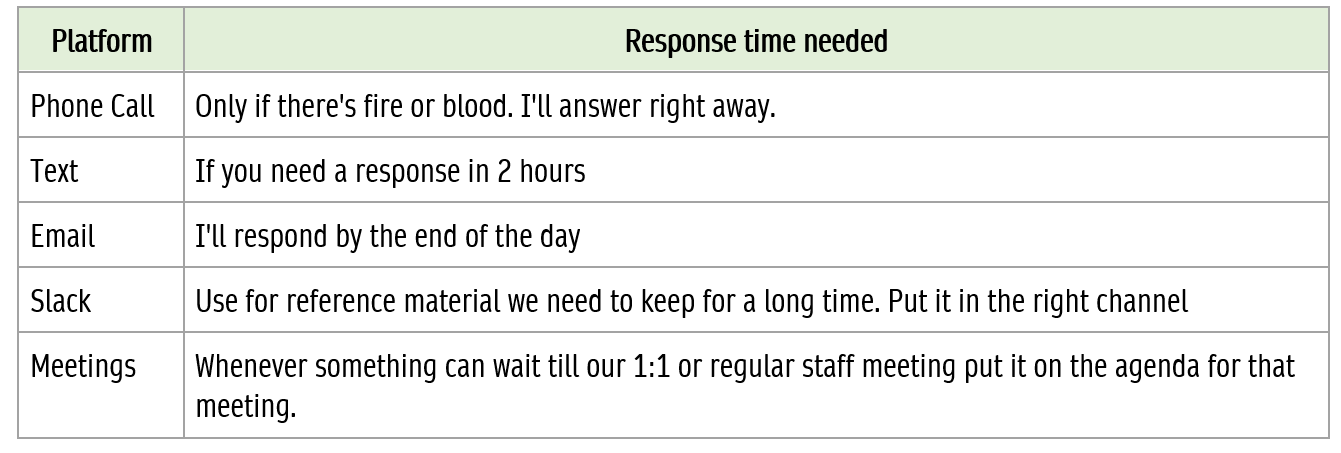
Perhaps this one should go under the “people” bucket because it enhances productivity but I keep it here because it should be reviewed annually. It’s a set of management policies that restrict what platforms employees use to communicate internally. I say restrict because there are probably half a dozen ways you could reach out to any employee right this minute. And just as many they could use to reach out to you. But having so many platforms is cumbersome. You should restrict their use.
One way to do this is to insist people use the right platform for the response time they need. A chart like this is a starting point – but it must be enforced.
Advisor Relationships
In addition to the lawyers and insurance brokers mentioned above, you may need relationships with CFOs, Bankers, Consultants, Coaches, or other advisors. As your company grows you may need a different set of advisors. So review them periodically. What advisors do you have? Which ones do you need? Don’t forget a peer group or advisory board. They can be incredibly helpful.
Speaking of Coaches
I have a slot for a new client in late August. Let’s talk if you might be the one. Book a free coaching call here.