Here’s How to Take The Next Step
How Do I Get Out From Under the Day-to-Day and Work On My Business?
That’s the most common question I hear from owner/operators.
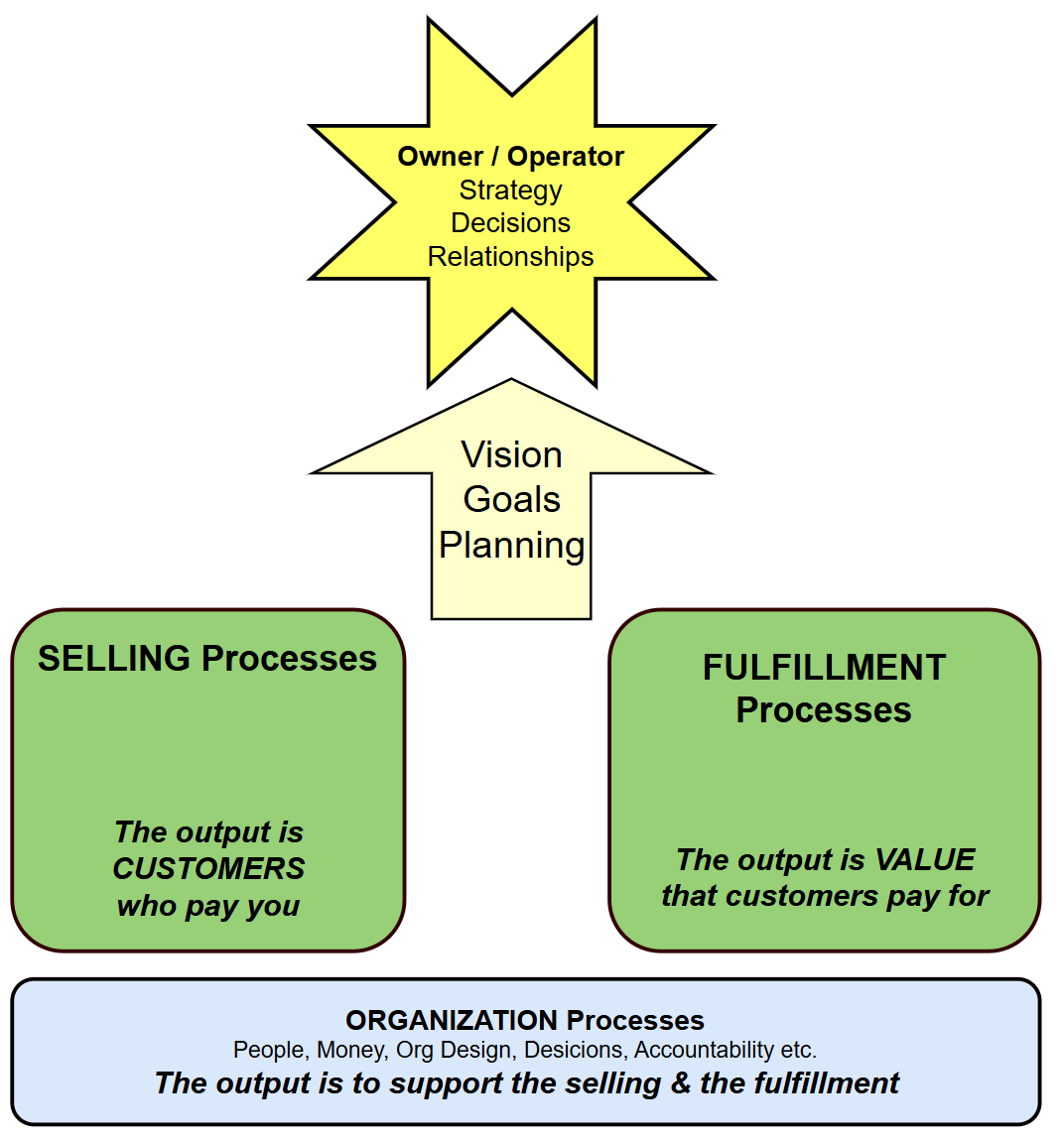
You’ve got people to sell or make what customers pay for. Those are the green processes in the image below. Your people either help you do these things yourself or depend on you to make key decisions and help them stay efficient. (By “people” I mean either employees or contractors you engage with regularly.) And they all report to you.
At this stage, you don’t need much in the way of organization processes (the blue in the image below). You mostly need to make sure the revenue gets collected and the bills get paid. And you’d love to do more of the stuff in yellow so the company can move forward. But you don’t have time. If you’re like many of my clients at this stage, you haven’t taken a vacation in … you don’t know how long.
Beware! You’re In Danger of Becoming Larry
Larry had a framing company. He and his crew would show up at a housing development to build the frames of the houses on top of the foundations someone else had poured. Then they’d move on to the next house so the electricians, plumbers and other tradespeople could come in and do their work.
Larry was taking home about a thousand dollars a week with just one crew. This was a good living back then. (About 250k a year in 2022 dollars.) Larry decided to expand, so he hired a second crew. Soon he was taking home $750 a week instead of $1,000. Well, that wasn’t quite working, so he expanded again and pretty soon he had three crews and was taking home only $500 a week.
Why?
Were his people lazy when the boss was away?
Did he hire people who didn’t know what they were doing? Were they not incentivized properly? None of these were the problem. But these questions all have one thing in common. They focus on the people, not the outputs those people produce.
It’s actually pretty common for owners of small companies to get into trouble when they step away from the day-to-day operations. And the assumption is it has to do with the employees. But usually that’s not the reason. You see, when Larry was on-site with his one crew, he was producing a certain output without even realizing it. And when he left the crews on their own, he didn’t replace that output. As a result, the crews couldn’t operate efficiently.
The crucial output he was producing wasn’t the frames he was building, rather it was an efficient and well-functioning crew that built the frames.
He was performing the role of a supervisor, often called a crew lead, or a team leader. And the output of a team lead is the improved performance of their team. Good team leaders produce this output not by berating people and pushing them to work harder. They do it by being responsible for things like scheduling, ordering supplies, quality checks, and prioritizing who does what when. And they protect the team from unnecessary meetings and interruptions. In other words, they help their teams do better work. That’s the true output of a team lead. All of this made Larry’s team more efficient and effective at building frames. (Often a team lead also jumps in to do the same work the team members do.)
But nobody did this when Larry wasn’t there. This is a common trap of running a company: it can’t seem to function without you. I’ve known business owners who go years without a vacation. Some don’t even take days off. But back to Larry. When he pulled away from his crew, he left a gap: the outputs he’d been producing as a team lead. And he didn’t replace himself in that role because he thought having good people was enough. Having good people is important, but building a strong business takes something else as well. Especially if you want that business to be able to do well when you’re not in the field with the crews.
If Larry had been aware of the gap he was leaving when the crew was on their own, it would have been a simple fix to train someone and authorize them to function as the supervisor and keep each crew working effectively. But seeing his company as a collection of people, he assumed if he got good people who knew how to build frames, that’s all he’d need.
Larry’s situation isn’t unique: too many owners feel trapped in their companies. The day-to-day work can’t happen without them being directly involved. This limits their ability to grow the company or even take a day off. This is a very common problem among company owners. And it stems from misunderstanding the role good people play in a company.
Unlike Larry, when I stepped away from the day-to-day work in my companies, I was aware of the results I was producing and I made sure that someone else would make them happen. That allowed me to focus on growing the company and freed me up to make some of the life choices owning a business should provide. You can see more of my story HERE https://ceobootcamp.com/about/ .
This takes a different mindset from the idea that all you need is good people. This new mindset is what I call Output Thinking. I wrote a whole book about it: OutputThinking.com. But for now what’s important is recognizing which of the outputs of your work are customer-focused (selling and fulfilling) and which are focused on supporting the team to do better work. Then hand off that supporting work to someone else.
Here’s How To Work On Your Business
Designate a Team Lead. If you’re not sure of someone’s ability, don’t make it a promotion. Make it a temporary assignment. The best worker isn’t always the best team lead. Look for someone who thinks systematically and also has people skills.
Describe the Outputs You Expect. These vary with the work the team produces. It could be training, scheduling, checking quality, motivating. The team lead’s outputs should make the entire team more effective.
Measure team Productivity. Do it now as a baseline then continually as the new lead takes over and you step back. Step back slowly – you want to delegate, not abdicate. Also, this forces you to communicate exactly what you mean by productivity.
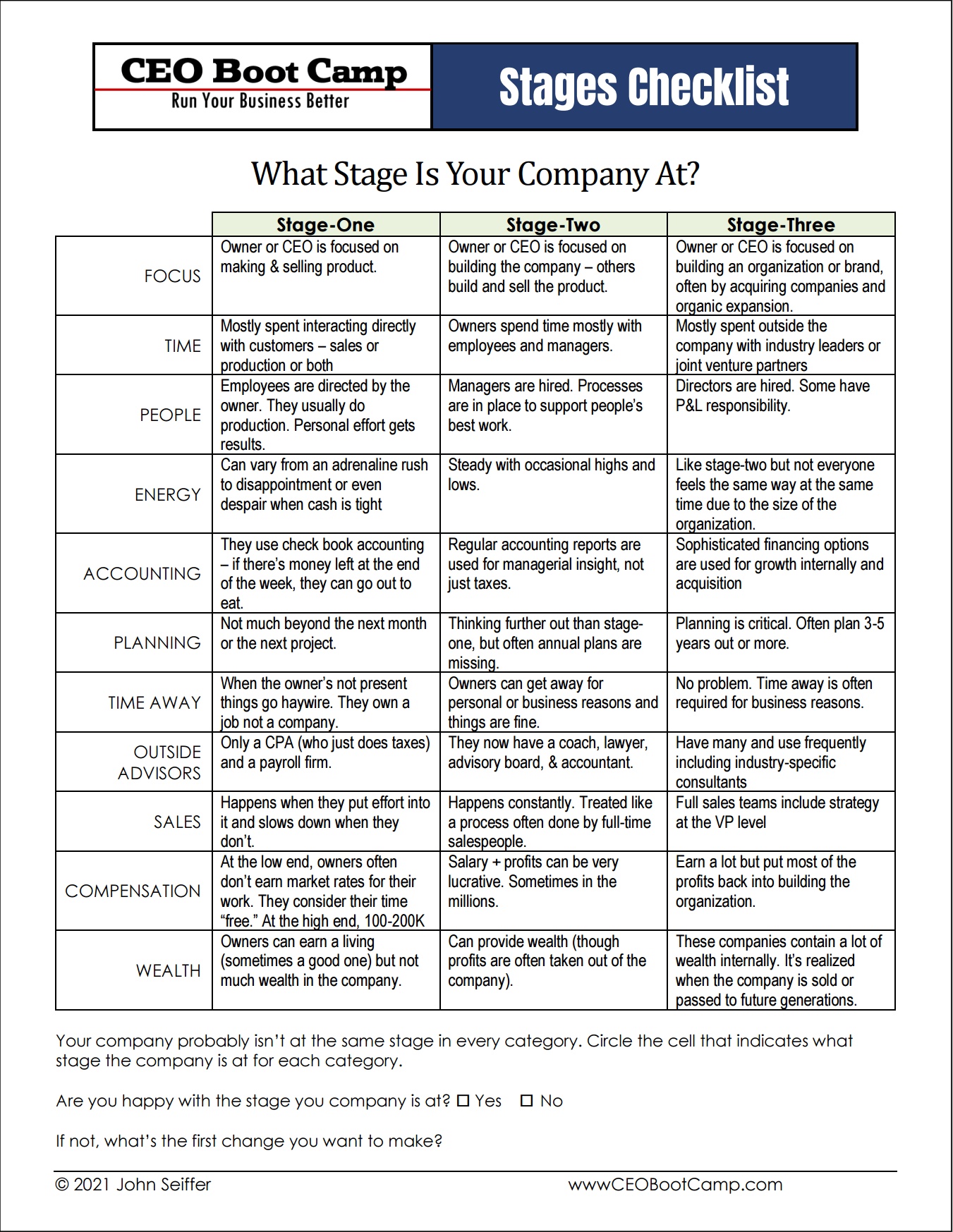
Empowering team leads is a critical piece of growing a Stage One company to Stage Two. It’s simple in concept but it’s the first step of putting the infrastructure in place that allows you as the owner/operator the freedom to work on other aspects of your company.
The trick is defining outputs in a useful way and providing the infrastructure for people to do their best work. I’ve been helping business owners and operators do that for over 30 years. Maybe I can help you too. Sign up for a free coaching session at