I’m Obsessed with systems – as if you couldn’t tell
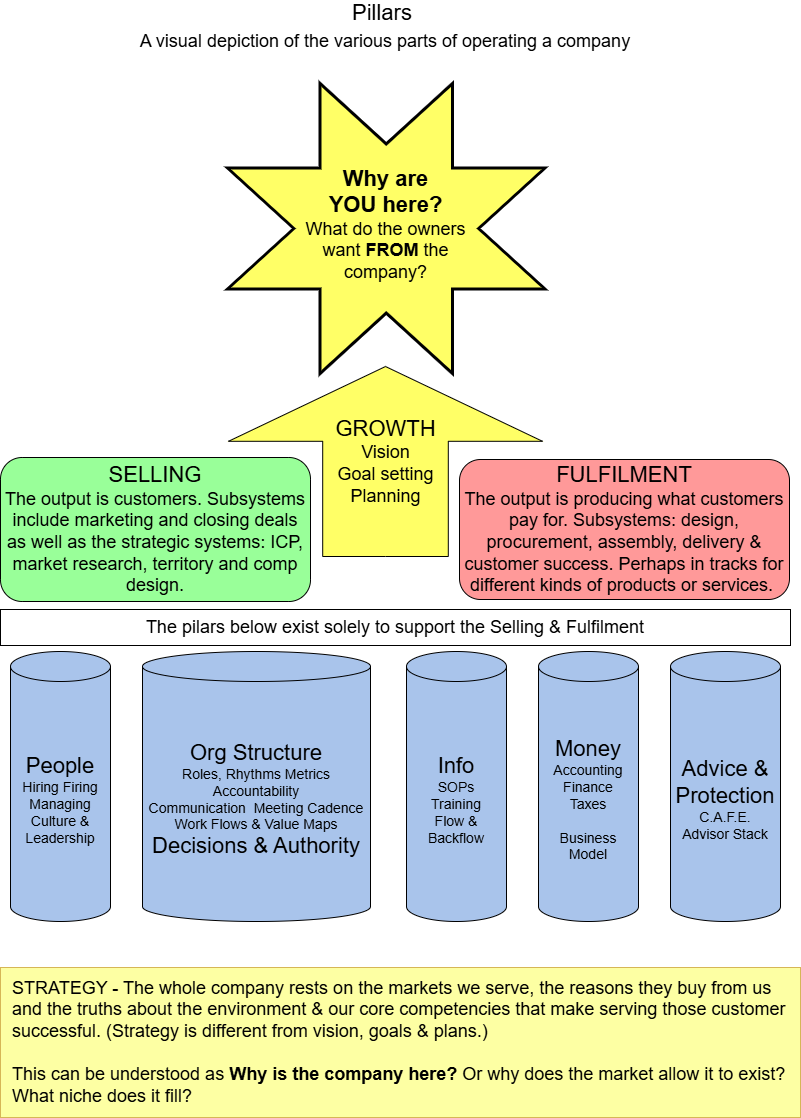
The colored blocks represent the major systems and with subsystems listed within them. Each system produces a number of outputs (results). Any successful company is producing relevant outputs in all of these areas. The difference is in how it’s being done.
Some companies produce their results primarily with experts who keep the wisdom of how to do it in their heads. I call that Grandma in the kitchen without a recipe. It works – food is wonderful. But it’s not very robust. That means it’s at risk. If the experts leave, there’s a gap that’s hard to fill. Even if they don’t leave, they often can’t be promoted without leaving a gap. And replacing grandmas experts can be very expensive – if you can find them at all. In addition, systems that are robust are more scalable. This keeps costs down and makes it easier to grow your company.
Here’s what makes a system robust:
How do your systems stack up?
Documentation. The system is documented so it can be done repeatedly by more than one person and new people can be trained to produce the output with no loss of quality.
Accountability. There is a single person accountable to produce each output. This person doesn’t have to produce the outputs, but they are responsible that they get produced.
Metrics. The output is measured so that quantity, quality, and any applicable attributes of the output can be tracked and improved. It’s important that you measure what’s important, not just what’s easy to track.
Subdivisions. This is perhaps the most important. As companies grow, the output that was produced by one person from start to finish can be broken out into subsystems such that the output of one is the input to the next.

Top Down or Bottom Up?
Founders and those who acquired their company after working in it tend to see the company from the bottom up. They’ve gotten their hands dirty making the product or generating sales (or both). They tend to know that certain relationships with vendors or customers are critical to success. But they’ve often cobbled together the other aspects of running a company: money, management, hiring, planning. As a result, they can get stuck in the tactical, daily work and can’t always achieve the growth potential they envision.
On the other hand, ETA searchers or Private Equity folks tend to look at the company from the top down. They see the numbers as cells in a spreadsheet but don’t always know how those numbers are produced. They often miss the nuances of what makes the company special because they think all the parts are replaceable. Mark Brooks has a great quote “Working hard comes before working smart.” They often miss that and end up trying to grow from a foundation that’s not as solid as they had hoped.
The Operator Accelerator
Both types of operators can benefit from making their systems more robust. That’s why I partnered with Chase Murdock and the Durable team to help speed up the skills of those who run SMB companies whether you got there from the bottom up or the top down. We’re launching a program called The Operator Accelerator.
Here’s how it works.
A six-month, small-group program with content PLUS tools to make participants a better business owner.
We meet every two weeks live (virtually) with a cohort of up to 20 other owners.
Each of the 13 modules focuses on one topic, a tool, and hands-on time to adapt that tool to your company.
We start with a scoreboard; they end with a stronger company AND a plan for continued growth.
What’s different is we combine content + hands-on adaptation to the participant’s company in a live session every 2 weeks.
Our first cohort is closing soon. If you’re interested, check out https://theoperatoraccelerator.com/