Different Outputs from a Single Person
When I read about the distinction between a Visionary and an Integrator in the EOS literature my first thought was “Those are just different names for CEO and COO – concepts that have been around forever.”
My second thought was “I guess if you’re going to build a network of franchisees selling a branded program, you probably want unusual names, but you really can’t change the concepts that it takes to run a company well.”
My third thought was “I don’t see how it makes sense for those two things to be done by different people, especially in an SMB-sized company (say, up to 30M in revenue, around 200 employees).”
I this piece I’m going to share three things about this idea that you can use.
The outputs produced by a CEO and a COO (or a visionary and an integrator if you must) are indeed different in kind.
Nevertheless there’s a reason why those two sets of outputs should almost always be produced by the owner of the company.
There are specific things you can do to be more effective at this.
The difference between CEO and COO outputs is Time Frame.
CEO outputs are strategic. They set the direction and vision of the company. They are long term and don’t change very often.
COO outputs are tactical. They keep the selling and fulfillment machines running daily. They deal with immediate problems that arise.
When done by different people it’s difficult to stay aligned.
It sounds good in theory to have different people produce each set of outputs. But it practice, it rarely works out.
For one thing strategic outputs don’t usually require 40 hours a week for an SMB company, unless there’s a crisis or some M&A activity. That means if the CEO has nothing else to do they are likely to keep coming up with new ideas that will at best be distractions for the rest of the team.
For another thing, the strategy needs to be based on the tactical competencies of the organization. Otherwise the vision and strategies won’t be grounded in the real world. After all, SMBs don’t have unlimited funds or capacity. And likewise tactical outputs need to be constrained by the direction the company is going and the understanding of where it’s not going. Otherwise there is a lot of wasted effort and money. This is not very easy to do when this work is divided between two people.
Even William Thorndike, writing about much bigger companies than SMBs, put those two responsibilities under one person when he said:
CEOs need to do two things well to be successful: run their operations efficiently and deploy the cash generated by those operations. [From The Outsiders by William Thorndike]
This makes me think of the Roman god, JANUS – the god of transitions and doorways because his two faces looked in both directions. The month of January is named after him. A business owner must likewise be looking in two directions. The best way to think of this is that the person at the top performs two very different roles. This may seem like a problem.

The Solution is Infrastructure & CEO Time
So where does that leave us? We have two different sets of outputs. One of which is less than a full-time job and one which might be more than a full-time job, yet they should be done by the same person.
Those of you who follow me regularly know I’m going to look at this through the lens of outputs. What outputs are required of each role – the CEO and the COO? (For those who don’t follow me regularly – I wrote a book about it. See OutputThinking.com )
Anything that a person produces is an output. Obviously making something like a sale, a hamburger or a plan is an output. But some outputs aren’t so physical – a decision is an output, so is a relationship.
All outputs have a trigger. Some are triggered by the calendar: payroll happens every other Thursday, financial reports are run on the 10th of the month. Others are triggered by an event: a prospect places a call to trigger a reply from the salesperson, or inventory reaches a certain level to trigger a reorder. And even those triggers that are not date-driven happen at a predictable frequency. Some happen multiple times a day, others only once a year.
Generally the more strategic outputs that are produced by the CEO role are less frequent and the COO role produces outputs that are more frequent. You can place these in the Eisenhower Matrix. COO outputs land in quadrant 1 and CEO outputs in quadrant 2.
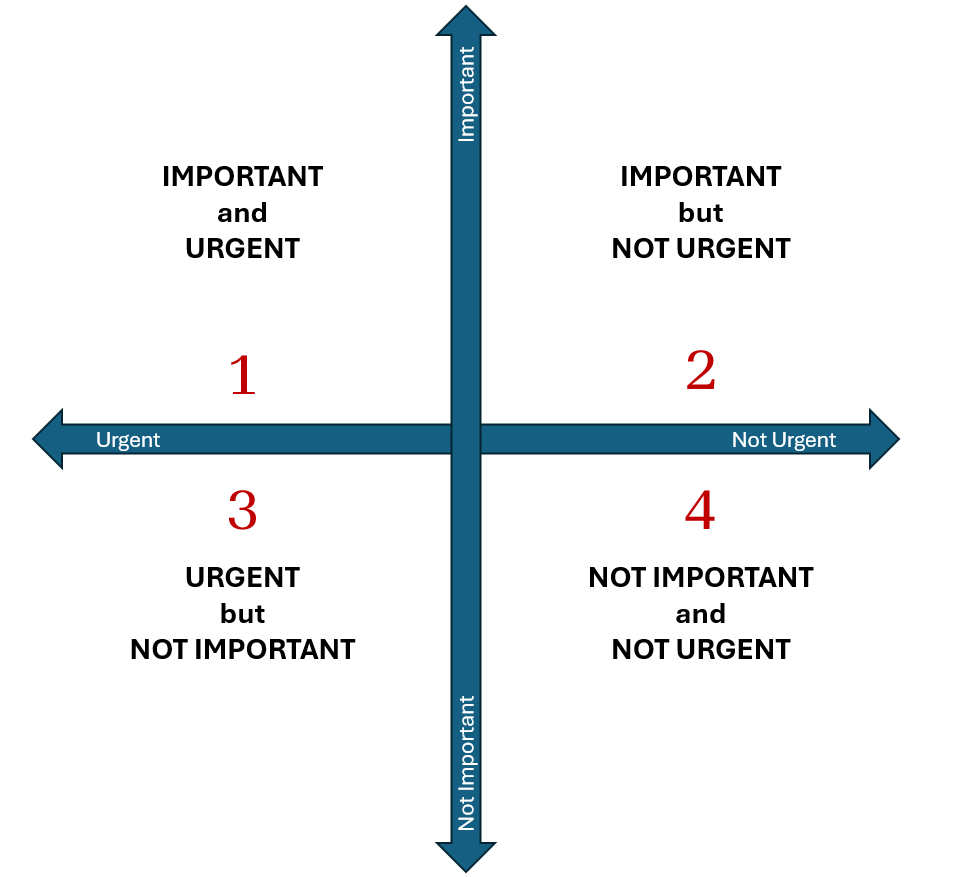
That means you must schedule time for the CEO aspects of your work. If you don’t it will get crowded out by the more urgent tasks. So how do you do two more-than-full-time jobs? That’s where infrastructure comes in.
First Build the Infrastructure You Need
You need a leadership team that can produce the urgent outputs while you retain accountability. This could be a single Chief of Staff or a group of leaders. I once had a client who had 6 people reporting to him and none of them was the second in command. They were each responsible for different aspects of the work and they each reported to him, the CEO.
Develop meaningful KPIs and give your direct reports all the support they need to thrive. That means tools, training, authority, personal and professional development, and of course, clear definition of expected outputs. You probably need regular meetings with them – perhaps daily. But these meetings don’t have to take long. A typical 15-20 minute standup agenda is ideal.
What did you accomplish since the last time we met?
What do you plan to do before we meet again?
What roadblocks do you foresee that you need my help with?
With a team like that, you must delegate but you can’t abdicate. You’ll be directing them like an orchestra conductor makes the music happen even though they don’t play any of the instruments.
This may take time. You’ll need to build a layer of leadership below you and maybe strengthen the layer below them – depending on how large your company is. What makes it develop faster is insistence on details, not high-level labels. For example, your sales team needs numbers of outreaches and follow-ups reported daily or weekly – not just revenue reported monthly. Your production team needs to know utilization rates and maintenance schedules and wastage.
Next Schedule CEO Time for Strategy
Building the infrastructure frees up your time to do the strategic, CEO work that’s important but not urgent. I’ve covered CEO time in the past. But I’ll add some tips below the video.
Be clear on the output you’re working on. (Be more specific than this list.)
Strategy? (new markets, new products etc)
Org restructuring?
Communication protocol?
Better KPIs?
Business Model adjustment?
Find a cadence that’s appropriate.
Some like to do a few hours a week.
Some dedicate a few days a month.
Find a special place – different from where you normally work.
A different room in your house.
A coffee shop.
A co-working space.
Warning – Pay Attention to What you Don’t Love
Notice which side of your “Janus” you’re naturally drawn to and which side you don’t like as much. I’m reminded of something Tariq Farid told me. He started Edible Arrangements & grew it from a single flower shop to over 1,000 stores. His insight? “What you don’t like in business will be your demise.” You may have to get good at the stuff you don’t love. Or at least know it well enough to delegate without abdicating.
Tales of 2 Clients
I worked with a client once with an MBA and who’d worked in a very regulated industry before he bought his company. He loved models. When his bank reneged on a loan he was expecting right after a major customer had demanded price cuts, his models were adding noise not signal. Models aren’t reality. As someone said, all models are wrong; but some are useful. It was hard for him to stop relying on approximations of formulas from his models and get his sales team to count number of leads and follow-ups daily and to put real numbers into a 13-week cash flow spreadsheet. But a good “Janus” has to know when to get real.
On the other hand, I had a client who didn’t have any models. He ran an advanced manufacturing company with about 50 employees and a number of 5-axsis CNC machines. He said he just walked the shop floor and could tell by the hum of the equipment if things were going well. But when we did the analysis, we learned his sales team had no way to generate leads that didn’t come over the transom. They didn’t know what % of RFQs were won or lost. Worse, nobody realized that his on-time delivery rate for his best clients was dismal. He just hadn’t put the numbers together to see all that.
You need to be Janus: working both sides of your company.
Want More?
If you found this useful, let’s talk. You can schedule a free coaching call HERE. I promise it’s a real coaching call and not a sales pitch.