Even though you think you can
I know it’s not a great idea to tell your audience that they’re wrong. But in my experience of working with hundreds of SMB owners it’s true. We aren’t really working on our companies (I’ll include myself here) even when we think we are. What we’re actually doing is working IN the company but with a slightly more long-term focus: that next hire, a new vendor relationship.
Why Being Wrong is Good News
If you’re always right – then this is as good as it gets. But if you understand where you’re wrong and why, then there’s the ability to improve. That’s what I hope you take away from this piece. Here’s where we’re headed.
I’ll share the 2 reasons you aren’t working on your business.
Spoiler – you don’t have the time, or you don’t have the skills.
We’ll look at what it really means to work ON your business.
I’ll give you a plan of how to get the time and the skills (and no, I’m not selling a course😂).
Your Shower Indicates if You Have the Time
Even if you use time blocking (and you should) and you block out a couple of hours a week, it’s not that this isn’t enough time to work ON your company. It’s that even when you do that, you may not have the headspace to really do it. Here’s how to tell.
What are the kinds of ideas you get in the shower or when you’re driving or when you first wake up? Are you solving problems at work? Are you remembering to follow up on that customer situation? Are you considering who your next hire will be? Those are “working IN” kinds of ideas. And they’re important, but they don’t really unlock real power of your vision.
When you have the confidence that all that stuff is taken care of by other people operating robust systems in your company, when you can go to work and have nothing urgent on your calendar, it frees up your headspace, your non-conscious mind to really work ON your company. And it will change your shower experience.
The other reason is the skills.
There are 3 parts of working ON a company. Nobody is great at all of them. The good news is you don’t have to be. You may not even have to be great at any of them (like a conductor who isn’t an expert at playing any of the instruments). But somebody you have access to needs to bring those skills into your organization. It could be an employee or a coach or consultant or some combination.
What are those skills? There are 3.
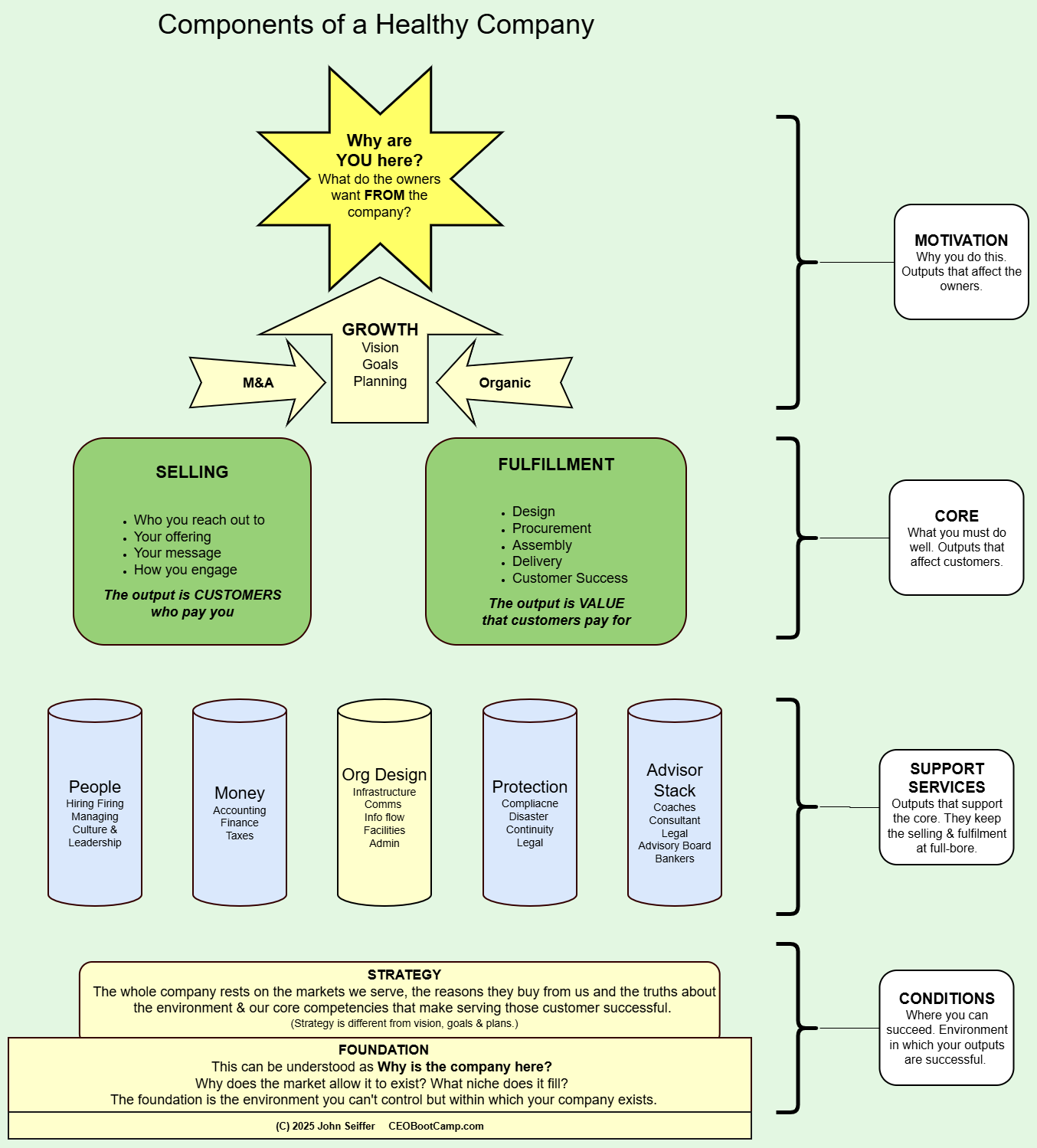
The parts in yellow are what I mean by working ON your business and they each take different skills. Let’s dive in.
Skill #1 – Strategy
Strategy sets the direction of the company. It answers these 3 questions:
Where do we play? (What markets do we serve?)
How will we win? (How will be delight customers in those markets?)
What must be true for our strategy to work?
These things don’t change much for an SMB company. You’re not opening up new markets or new divisions very often. So it’s worth spending a bit of time writing down the answer to those questions. Then review them once a year or so to see what’s changed (especially that 3rd question).
Skill #2 Goals & Plans
Goal setting and planning are things that most people do but often not very well. You may have quarterly or annual reviews. You may even bring in an outside facilitator (which is something I recommend, by the way). But a good plan must be referred to constantly. It must guide decisions telling you what to focus on and what to say no to. And everyone must know how their day-to-day work contributes to the plan. Here are the attributes of a good plan.
Specific goals so you know if you’ve succeeded.
Milestones (with dates and numbers) so you can course-correct.
Resources you’ll commit. If you don’t commit resources, nothing different will happen.
Assumptions. What must be true for this to work, so you can adapt if something changes.
And you know that quote by Eisenhower that plans are useless, but planning is everything? It’s often taken out of context. He was specifically talking about in an emergency or crisis. Not for normal situations. In normal situations plans are wonderful when they’re done well and adhered to.
Skill #3 Organizational Design
This is the part where many company owners need outside assistance. I’ve worked with hundreds of people owning companies from 2 to 20M in sales (about 10-200 employees). And in my experience, people who build companies like that are very intuitive, very quick and have good instincts. But often they aren’t procedural or process oriented. That’s fine. They don’t have to be. They can bring in or partner with someone who is. In the companies I’ve worked with it usually takes 12-24 months to put the right systems in place. That’s when things really take off.
You know that saying about putting the right people in the right seats on the bus? That was written by someone who consults with large, public companies. SMBs often need someone to build the seats and maybe even the bus. Henry Ford succeeded not because he had the best mechanics with the best tools. He had someone design the assembly line so those mechanics could crank out model Ts. The infrastructure that allows people to do their best work is what I mean by organizational design.
In my experience it’s after this is done that the owner has the headspace to really work ON the business; to focus on that gold star at the top of the diagram. Then they can build the company so it gives them what they want – money, time for a personal life, work they love, leaving a legacy, launching into a holdco or philanthropy – whatever it is that got them into the company in the first place.
How to Work ON Your Business
If this rings true to you, here’s how to start.
Take stock of where you are. What do you spend your time doing? What occupies your headspace? Writing this stuff down in a CEO Notebook is a good way to see patterns.
Do a Systems Inventory. Look over the diagram above and see which parts are dependent on you, which are dependent on other experts in the company, and which are happening because of strong robust systems – what I call DAMS. https://johnseiffer.substack.com/p/all-the-company-systems-in-one-diagram
Plan some CEO Time. Use it to prioritize how to give away the things that are taking your headspace away from being strategic.
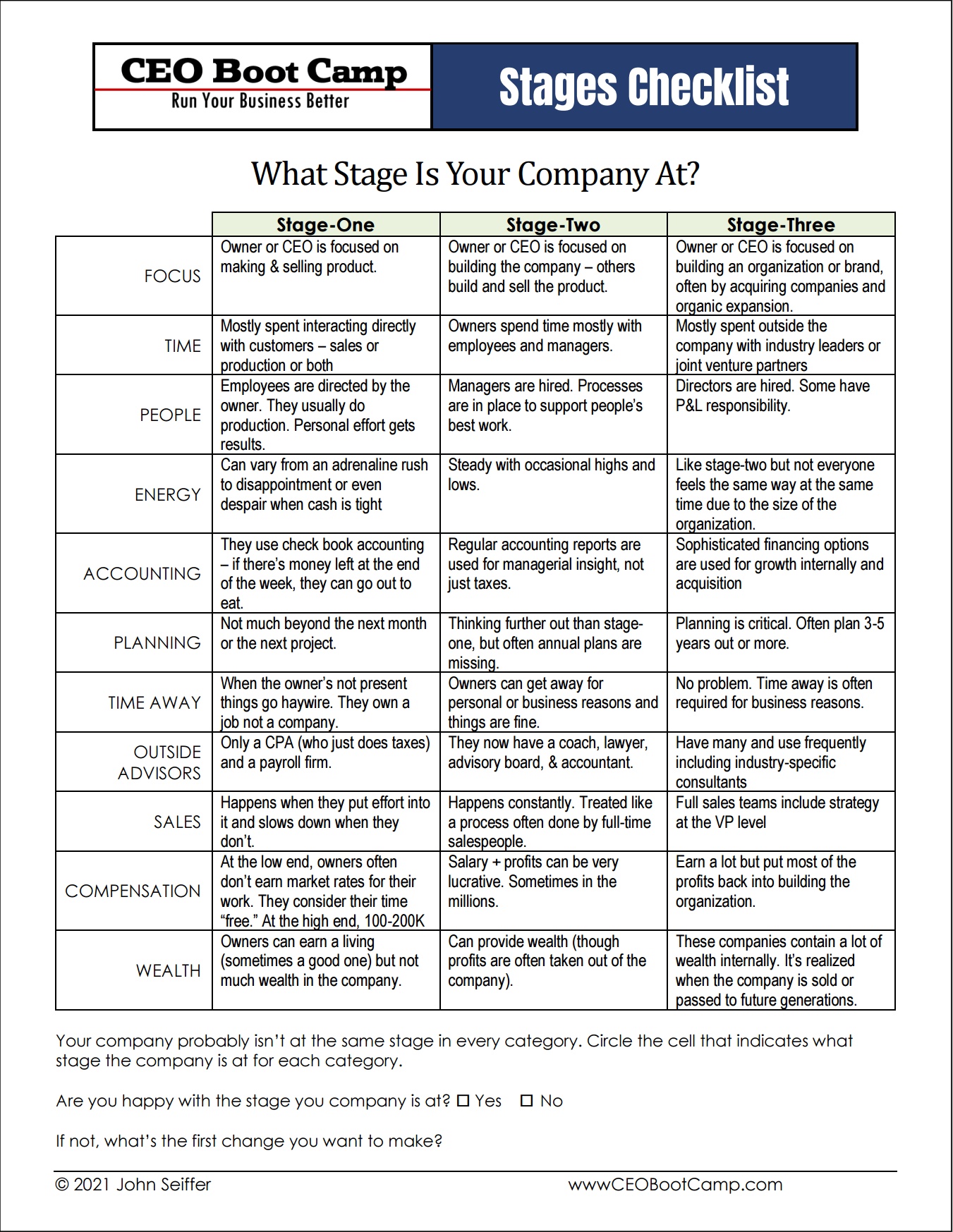
This means you’ll be growing your company toward a solid stage 2 or even stage 3 company.
If you don’t know where to start, I offer a free coaching session. It won’t be a complete solution (and it certainly won’t be a sales pitch) but it will be a start. https://john-3.youcanbook.me/
Thanks for reading.